
Can We Save What We Haven’t Yet Recorded? The Race to Document Indigenous Sign Languages
 Imagine a library filled with thousands of books, each containing the history, medical secrets, and stories of a unique culture. Now, imagine that these books are written in a special ink that disappears forever when the last person who can read them passes away.
This is the reality for many indigenous sign languages around the world. Because they are not written down or filmed, they are invisible to the global record. We often ask, “Can we save our heritage?” but the harder question is: Can we save what we haven’t yet recorded?
The answer is a difficult one. Once a language is lost, it cannot be recovered like a lost file on a computer. When the last signer dies without being documented, a unique way of human thinking disappears forever.
Why “Lost” Means “Gone Forever”
Spoken languages can sometimes leave behind clues, written scripts on stone or old letters. But sign languages are three-dimensional and live only in the movement of the hands, the face, and the body.
If a small community in a remote part of Nigeria or the Amazon has a unique sign language, and they are forced to switch to a national sign language (like ASL) or if the community moves away, their original language begins to fade. Without video recordings or a written dictionary of their signs, there is no way for future generations to “re-learn” it. You cannot dig up a sign in an archaeological site.
Real Examples of Languages We Have Lost
The disappearance of sign languages isn’t a theory; it is happening right now. Here are examples of languages that have been lost or are on the very edge of disappearing because documentation started too late:
- Martha’s Vineyard Sign Language (MVSL) – USA
In the 17th and 18th centuries, on an island in America called Martha’s Vineyard, there was a very high population of Deaf people. Almost everyone on the island, Deaf and hearing, spoke MVSL. It was a beautiful, fully inclusive society. However, as the islanders began to marry people from the mainland and schools for the standard sign language opened, MVSL began to die. The last native signer passed away in the 1950s. Because modern video technology wasn’t used to record the full depth of the language, it is now considered a “dead” language.
- Sandy River Valley Sign Language – Jamaica
In a small village in Jamaica, a unique sign language developed naturally. For years, it was the heartbeat of the community, but as the community became more connected to the cities and young people learned Jamaican Sign Language (which is different), the village signs were forgotten. Today, only a few elders remember bits of it, and much of the original language’s grammar is lost to history.
- Various Indigenous Plains Signs – North America
While Plains Indian Sign Language was documented in bits and pieces, many specific tribal variations were lost during the era when indigenous children were forced into boarding schools. In those schools, they were punished for using their native signs. By the time researchers arrived to record them, many of the specific, sacred signs for tribal ceremonies had already vanished.
The “Silent Emergency” in Africa
In Nigeria and across Africa, organizations like S-DELI and IHAV have identified that there are many village sign languages that have never been put on a map.
In some rural areas, families have developed complex signing systems over hundreds of years. But because these aren’t official, they aren’t taught in schools. When the elders pass away, the children, who may have moved to the city, carry only memories, not the language itself. We are currently in a race to find these hidden languages and record them before they become another Martha’s Vineyard.
How Documentation Acts as a “Safety Net”
Documentation is the only way to stop a language from disappearing into thin air. By using technology, we can create a permanent record.
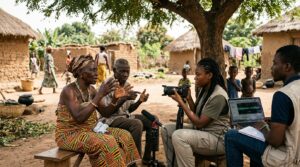
- Video Archives: Filming elders as they tell stories ensures the movement of the language is saved.
- Linguistic Mapping: Marking where these languages are spoken helps governments recognize them as official cultural heritage.
- Digital Tools: Apps like Omenkaapp can be used to store and share these signs so that a child in the future can look at their phone and see how their great-grandparents communicated.
A Call to Action: Record Before It’s Too Late
We cannot save what we ignore. If you know of a community where a unique local sign language is used, don’t assume someone else has recorded it.
- Advocate: Support organizations like S-DELI that do the hard work of field research.
- Use Your Phone: If you have an elder in your family who uses indigenous signs, ask for permission to film them telling a simple story.
- Spread the Word: Let people know that sign language is not “one size fits all.” Every local sign is a treasure.
As the proverb goes, “Ihe e dere ede, ka a na-agụ“ (It is what is written down that is read). If we don’t write these sign languages into our digital history today, there will be nothing left for our children to read tomorrow.
